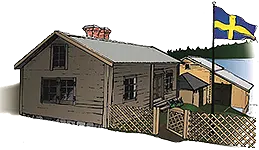
Heritage trail
1. How did the place Ulvöhamn come into being?
In an era when seafaring ruled and the fishing industry was crucial for prosperity, Ulvöhamn was hard to surpass—so what do the myths say about the island’s name?
The riches of nature have drawn people to the Ulvö Islands throughout history. Everything was here: a sea rich in fish, a large sheltered harbor, forests providing timber and fuel, and land to cultivate. But it was the herring above all that laid the foundation for Ulvöhamn’s emergence. The real boom came during the 16th and 17th centuries, when fishermen from Gävle began seasonal fishing on the island. This fishery was later taken over by tenant farmers from nearby mainland villages. It was not until the latter half of the 19th century that Ulvöhamn gained a permanent population, quickly growing into the largest fishing village in Norrland. All of this developed within an older agrarian setting, where farmers on the island remained an important part of the community well into the 20th century.
And the name Ulvön? Well, there are many legends: a wolf—or perhaps a whole pack? Hardly, as wolves likely only appeared on the islands temporarily. Could Ulvön have been named after an early settler called Ulf? More likely. Or was it the giant Ulf who hurled two enormous boulders into the sea, thereby forming the Ulvö Islands? No one knows for sure! Maybe you have your own idea?
2. Fishing and fermented herring (surströmming)
It was not only the fish and the fishing itself, but above all the small salting houses that made Ulvöhamn known even beyond the country’s borders—but what is it that makes Ulvön famous today?
Today, there are no active professional fishermen or surströmming producers left on Ulvön. However, during the 19th century and the first half of the 20th century, herring fishing—“the silver of the sea”—formed the entire foundation of Ulvöhamn. Whitefish and salmon were also caught, and seabirds and grey seals were hunted, the latter for their skins and blubber. In more modern times, cod has also been fished periodically. The distance to the mainland made it difficult to sell fresh fish, so Ulvö fishermen focused on producing surströmming and especially salted herring, which was considered a staple food along the Norrland coast.
The preparation of surströmming on Ulvön remained relatively small-scale until 1897, when J. A. Söderberg’s salting house began canning it in tin cans, after which production truly took off. At its peak, there were nearly ten commercial producers in Ulvöhamn. With brands such as Ulvö Gamla Salteri, Röda Ulven, and Ulvöprinsen, Ulvön has—despite competition from other places—continued to be regarded as the “Mecca” of surströmming. This is largely thanks to the establishment of the Surströmming Academy and several other surströmming societies, which have also helped make this fermented fish—considered a delicacy—known internationally.
And what about today? Professional fishing and the salting industry have ceased, but together with surströmming they will always be associated with Ulvön. Tourism, which has existed somewhat in the background for over 100 years, has now taken over as the island’s main industry.
3. The school on Ulvön
A small primary school on Ulvön with 52 children in 1905, to boarding on the mainland 65 years later—a tough reality for a nine-year-old.
Since 1842, compulsory schooling has applied in Sweden, but it was not until 1894 that education is known to have been conducted on Ulvön. At that time, there was no school building; in the early years, lessons were held in a so-called “fin room” in one of the farmers’ houses on the island. In 1905, a newly built school was inaugurated in Sörbyn, in the middle of the island, so that it would not be too far for all the children coming from Storviken in the north to Ulvöhamn in the south. At that time, there was no school transport, so the 52 children had to walk, or in winter use skis or a kick sled.
Teaching continued until 1970, when the population had declined sharply in recent years and only five pupils remained on the island. It was then decided to move schooling to the mainland school. The students were boarded with families in Köpmanholmen and came home only on weekends and holidays. This was a very difficult adjustment for both children and parents. For a nine-year-old from Ulvön, living away from home on the mainland was a major change compared to being able to return to their parents on the island every day.
However, in the mid-1970s, younger families moved back to Ulvön, and in 1985 the school reopened on the island. It was located in the community building in Ulvöhamn, where teaching continued until 1991, when it was closed again—this time for good? The original
school building, now privately owned, still remains and is located directly to the right when entering Sörbyn from the direction of Ulvöhamn.
4. Mining on the Ulvö Islands
“Iron Ulvön,” a large mining community? No—rather a water-filled pit in the rock, 163 meters deep, along with stories of three men on a skerry and a crate of grey stone that went missing.
As early as the mid-17th century, it was known that there was iron ore on Ulvön, both on the northern and southern islands. Since then, mining has taken place with several interruptions and varying results, continuing up until 1961. Remnants of this activity can be found in many places on the islands. The ore body itself is relatively thin—no more than about one meter thick—and contains, in addition to iron, vanadium and titanium. It is exposed in several locations, such as at Gruvmyran on the northern island and at the former fishing village of Marviksgrunnan at the far end of the southern island.
In recent times, some buildings from the most recent mining era have been restored, including a machine hall and a mine headframe. The shaft is now filled with water but reaches an impressive depth of 163 meters. The mine is located on Södra Ulvön and can be reached via a path from Sandudden in Ulvösundet, opposite Brattberget on the northern island. All visits to this site, as well as other mine shafts on Ulvön, are at your own risk.
There are also some rather amusing incidents connected to mining operations, such as when three men were stranded for three days on Gråskärsbådan—a small barren skerry off Ulvön—after their heavily loaded boat sank. Or when a major business deal collapsed because a coastal ship captain threw a crate of what he thought was worthless grey stone overboard, not realizing it contained ore samples intended for potential buyers in Norrbotten.
The difficulties of maintaining continuous, efficient, and economically viable mining on Ulvön have mainly been due to problems with transporting and loading ore, as well as shipping it by boat—but also because the ore body is simply too thin. Today, Södra Ulvön is part of the Ulvö Sea Nature Reserve, making it even less likely that iron mining will ever resume on the islands.
5. Communication
Ice boats, “Loppan,” “Amfibien,” hovercraft and air cushions—but a Russian Tsar was also involved.
During the summer season, there have historically always been boats—large and small—to maintain communication between Ulvön and the mainland. Not always without problems, however, and it was during the winter that many breathtaking stories of hardship on the ice were created, when transport was truly put to the test. Daily connections with the mainland were in fact a high priority even in winter, especially to maintain mail services (the post office on the island opened in 1901), but also to ensure clear ice routes for urgent medical transport.
From the very beginning, summer transport relied on privately owned boats, and in winter on “apostle horses” (walking), real horses, skis, and sleds. Eventually, coastal steamers arrived—passenger ships that called at Ulvöhamn while traveling along the Norrland coast between towns. It was not until 1940 that Ulvöarna gained its first regular scheduled boat service, the old Nätra Express.
Over the years, technology steadily developed. Boats became more modern, larger, and more powerful, gradually extending the operating season. In winter, transport also began to include jeeps, trucks, and later snowmobiles. The great challenge, however, was managing crossings when the ice neither “held nor broke.” First came ice boats, then Loppan, Amfibien, and the Hydro-copter, followed by the hovercraft. Each had its advantages but also its limitations. Today, helicopters are used for emergency transport. Mild winters have also contributed to the fact that today’s Ulvö ferry can, in some years, operate across most of the winter season.
And that story about the Russian Tsar: he ordered a tugboat from Motala Workshop, but a revolution intervened. The ship remained in Sweden and eventually ended up in the High Coast—becoming Ulvön’s first passenger vessel, the Nätra Express.
6. Ulvö Cemetery
On an island in a lake on an island in the High Coast—and the fate of a Stockholm resident.
Ulvön has a picturesque small cemetery located on a tiny islet in Lake Bysjön, about 2 km from Ulvöhamn. It is one of the most beautiful cemeteries one can find. Until 1920, before it was established, the people of Ulvön were buried in Bjästa on the mainland. This was not very practical for the islanders, so the need for a local cemetery grew. A farmer in Sörbyn then donated the small islet in the lake to the people of Ulvön for this purpose. A small causeway was built out to the island, and everything was ready for its inauguration.
A man named Harald Klockhof Dahlén attended the opening. He was so moved by the place that when the opportunity arose, he said to the priest: “This is the most beautiful resting place I have ever seen; here I would like to lie.” But Dahlén and his family lived in Stockholm, so the statement remained just words.
A walk along the scenic country road that winds along the lake toward Sörbyn is highly recommended for a visit to the cemetery. In this relatively young burial ground, today’s Ulvö descendants recognize most of the names on the gravestones. “It feels like stepping back just a couple of generations and walking through a history book.”
On one grave, marked with a small iron cross, it reads:
“If I take the wings of the morning, I would seek a dwelling at the farthest end of the sea, where Your left hand shall guide me and Your right hand hold me.”
— The grave of Harald Klockhof Dahlén.
Two years after the inauguration, Dahlén drowned during a visit to Söderhamn. The following spring, his remains washed ashore about 20 miles (roughly 20 miles northwards in the text’s description) on Ulvön, where he was laid to rest in the island’s cemetery. His wish was thus fulfilled.
7. Ulvön’s population development
People from Gävle came first—initially only as “summer visitors.” Over time, many fishermen, some farmers, master pilots, and even miners came to live here on the island.
Ulvön was originally colonized by fishermen from Gävle, who had held fishing rights along the Norrland coast since the 15th century. However, the island’s first permanent settlement was not established until the 1550s, in Sörbyn further inland, where four settler families—farmers—made their homes. These were the people who eventually built and rented out the first fishing huts in Ulvöhamn. A permanent population there is believed to have been established only in the mid-19th century, consisting of Gävle fishermen and landless coastal fishermen. These fishermen remained tenants of the island’s farmers until 1918, when the “Ownholding Act” (ensittarlagen) was introduced. This law allowed them to purchase their homes, boathouses, and drying racks.
The period around the turn of the 20th century was Ulvön’s true golden age, when the island had its largest population—about 350 people. Most lived in Ulvöhamn, which also served as a hub for shipping and infrastructure in Norrland. Fishing was in full swing. Freight transport, postal handling, and storage depots for goods such as coal and other fuels were managed from here, and mining operations were also underway. Agriculture flourished, and farmers had strong demand for their products. The island truly buzzed with activity. This era—with its fishermen, pilots, merchants, craftsmen, and various service workers—shaped Ulvöhamn into what it still is today.
After World War II, however, demand for herring—both salted and fermented—declined, and one salting house after another was forced to close. Roads and railways began to outcompete maritime transport, and the situation worsened when the Ulvö pilot station was closed in 1967. Younger generations had already started moving to the mainland in search of new jobs and professions. Today, in 2024, only around 30 people live permanently on Ulvön.
8. Ulvön’s economy
A hub for shipping, telegraph services, foundation stone quarrying and dance halls—but a shortage of carpenters.
Ulvöhamn, with its central location and sheltered harbor, was around the turn of the 20th century a hub for maritime traffic in the Bothnian Sea, with a wide range of activities. Until then, fishing, agriculture, and also mining had completely dominated the local economy. Coastal and freight vessels stopped here to take on provisions and coal. By this time, Ulvöhamn had three general stores, a bakery, and a café, and tourists began to arrive in large numbers. A hotel with a cold bathhouse and the Graneliden guesthouse were built, followed later by two dance halls and several “cottage villages.” Both car and boat taxi services operated on the island.
At the same time, fishing, salting houses, agriculture, and at times mining were in full swing. The pilot station, which had existed since the 18th century, was an important employer in Ulvöhamn. The post and telegraph office employed a handful of people, and construction was booming, requiring foundation and base stones that were quarried locally on the island. From the mid-1950s, a few boatbuilding yards were also operated, with the owners themselves as workers, and in the 1980s there was also a large salmon farm on the island.
Most of this has disappeared today, and the tourism industry has completely taken over.
The municipality is responsible for operating the Ulvö ferry as well as water and sewage year-round, which together employ fewer than ten people. Several restaurants have been added in Ulvöhamn in recent years, complementing the shop, kiosk, cottage rentals, and hotel during the summer season. The need for craftsmen has therefore been high on Ulvön—more so than for a long time, especially in Ulvöhamn. In the past, two or three permanent residents worked full-time with construction and carpentry, but today it is no longer possible to hire such workers locally; instead, builders now come in steadily from the mainland.
9. Bonfires / Walpurgis fire (Våreldar / Majbrasa)
Flag displays and music, a 50-metre rope, and a burning sawed-in-half boat.
Bonfires have a long tradition worldwide, and especially in the Nordic countries. A fine old custom in Ulvöhamn was that every Walpurgis Night (Valborgsmässoafton), a decommissioned boat was burned up on Lotsberget (Pilot Hill). Boats in Ulvöhamn traditionally held high status and deserved a dignified farewell. For this reason, the boat was decorated with a beautiful set of flags and pulled through Ulvöhamn with a long rope by both young and old. Everything took place to the music of a fiddler who rode in the boat, often accompanied by some of the younger children.
Once at the site on the hill—the “sacrificial place”—the boat was sawed in half and set up as part of the May bonfire.
This tradition has its roots in the period leading up to the First World War, when many refugees arrived by rowing boat or sailboat to Sweden, especially from Åland, with several ending up on Ulvön. They later continued to the mainland, leaving some of their boats—often in poor condition—along the shores of Ulvösundet. In 1916, the people of Ulvön therefore joined forces and decided that every Walpurgis Night, a boat would be burned.
Later, local fishermen also contributed their own worn-out boats. While the tradition delighted many, it also marked the end of a long working relationship with the boats, which required a certain sense of respect. It is said that the owner was not supposed to attend the burning itself, but instead stay at home and reflect on the fate of their old working companion.
However, wooden boats have become scarce. Parts of the tradition still remain today. Since 2009, the boat is no longer burned, but instead is pulled year after year through Ulvöhamn with the long rope, just as before, accompanied by flags and music.
10. The nature and geology of the Ulvö Islands
Rotten stone, magnetic sand, orchids—and a world record.
What most people first think of are Ulvön’s shores, characterized by their red cliffs. These are often somewhat angular and sharp in shape, as the rock easily cracks and breaks apart. This is Nordingrå granite, or rapakivi granite as it is called in Finland, where the name roughly means “rotten.” This distinctive type of rock stretches from the area around Ulvön out into the sea, only to reappear again in Åland. In addition to granite, the bedrock also consists of black diabase, which is not only rich in iron ore but also contains valuable alloy metals such as vanadium and titanium. On some sandy beaches on Ulvön, you can find darker patches of sand—these originate from the iron-rich diabase and are therefore magnetic.
Ulvön is a paradise for botanists, as the island is marked by an unusually rich diversity of species. This is partly due to the lime-rich soil, but above all to the influence of the sea on spring and autumn temperatures, allowing both typically southern and northern plant species to thrive here. Here, orchids that usually require the calcareous soils of Gotland grow side by side with hardy mountain species.
Since the inland ice melted more than 10,000 years ago, the High Coast has risen 286 meters out of the sea due to land uplift—a world record. Ulvön is still rising by just over 8 millimeters each year. Anyone exploring the island can find many traces of this uplift. It begins already here in Malabacken, where the road passes straight through a large shingle field of stones once rounded by the waves of the sea. In various places on the island, you can also see remnants of shells from marine mussels and snails from long ago.
11. The pilots (harbour pilots) on Ulvön
A long-running presence that, with binoculars, created safety and security for the people of Ulvön.
Shipping traffic was intense, and Ulvön—strategically located at the outer edge of the coastal archipelago along the Bothnian Sea, and close to Örnsköldsvik and the Ångerman River with its many forestry industries—was an obvious place for a pilot station. This was already understood long ago, in 1725, when the pilot station in Ulvöhamn was established.
From then on until 1967, when operations were moved to the mainland, it was possible to request a pilot from Ulvön. The station itself was centrally located in the harbour, on the same site that today houses the Ulvö Museum. Up on Lotsberget (Pilot Hill), the pilot lookout was located, and as long as the sea was ice-free, it was staffed around the clock. Before radio communication existed, contact with ships was maintained using international signal flags. When vessels approached the island, pilots could see whether they requested assistance and confirm their intentions in this way.
Over the years, many pilots and boatmen earned their livelihood through the Swedish Maritime Pilot Service, which historically was an important employer on the island. When the pilot station closed in 1967, many younger residents had already moved away, and the closure became a severe blow, especially for Ulvöhamn. A crucial foundation for both the shop and the school disappeared almost overnight, and just three years later the island’s school was also closed.
The pilot lookout itself provided an important sense of security for the people of Ulvön, as there was always someone up there with binoculars keeping watch over the sea. On several occasions, the pilots were able to assist fishermen and other seafarers who had gotten into trouble at sea. A visit up to the pilot hut is highly recommended—the view is magnificent.
12. Ulvö Old Chapel
A simple 400-year-old building—one of the oldest in Västernorrland—with invaluable wall paintings was saved by a king.
Ulvö Old Chapel, located up here, was built as early as 1622 by fishermen from Gävle—but not on this exact site. Originally, it stood much farther into the Ulvösundet strait. Its original placement may be linked to land uplift, which has lowered the water level by as much as four meters up to the present day. At that time, Ulvöhamn was not as sheltered from wind and
weather as it is today. Eventually, however, the chapel was moved to its current location, where it served not only as a place of worship but also as winter storage for the fishermen’s gear—kept “under lock and key.”
You might have wondered why small chapels were built in nearly every fishing village along the coast. The reason is directly tied to the church attendance laws of the time. In places like Ulvöhamn, it was difficult to travel to the mainland for mandatory church services, so local
chapels became necessary.
At the end of the 19th century, a much larger and more modern church was built. By then, the old chapel had already begun to deteriorate, and a demolition permit was granted in 1888. However, when King Oscar II visited Ulvön two years later, he recognized the chapel’s value—especially its remarkable wall paintings—and immediately donated 200 riksdaler for its preservation.
Today, the chapel is owned and managed by the County Museum Foundation of
Västernorrland, with guided tours organized by Ulvö Museum.
13. Kvarnsjön
At four o’clock on a spring morning in 1924, the people of Ulvön were awakened by a terrifying roar. Was it war, or was a thunderstorm worse than ever before?
The people of Ulvön were a resourceful community, used to solving most problems themselves. When kerosene for their lamps ran out and carbide lamps proved too dangerous, they decided to build their own hydroelectric power plant at the outflow of Lake Kvarnsjön. What they were after was electricity for lighting—“light,” as they called it. Said and done, everyone contributed, both with labour and money, and in 1917 the facility was inaugurated. The dam was impressive, and the generator worked perfectly—but only when there was enough water, meaning in spring and autumn. In between, the lamps remained unlit.
In 1923, it was therefore decided to raise the dam by another meter, and in the spring of the following year the water level in the lake had been raised to a total of 7 meters.
“We weren’t engineers,” said Axel Söderberg, one of the initiators, “so things went as they went.” The dam had not been anchored into the bedrock, it was built concave instead of convex, and the pressure from the spring flood undermined the structure. At four o’clock in the morning, the dam finally burst with a deafening roar. The power station building and the mills were swept out to sea, and all that remained were a few millstones and the remnants of the dam that can still be seen today. No one was injured that night, but all the money and work had been lost. “All our property has come to nothing,” and the island was left in darkness—both the lamps and the mood.
In an era when seafaring ruled and the fishing industry was crucial for prosperity, Ulvöhamn was hard to surpass—so what do the myths say about the island’s name?
The riches of nature have drawn people to the Ulvö Islands throughout history. Everything was here: a sea rich in fish, a large sheltered harbor, forests providing timber and fuel, and land to cultivate. But it was the herring above all that laid the foundation for Ulvöhamn’s emergence. The real boom came during the 16th and 17th centuries, when fishermen from Gävle began seasonal fishing on the island. This fishery was later taken over by tenant farmers from nearby mainland villages. It was not until the latter half of the 19th century that Ulvöhamn gained a permanent population, quickly growing into the largest fishing village in Norrland. All of this developed within an older agrarian setting, where farmers on the island remained an important part of the community well into the 20th century.
And the name Ulvön? Well, there are many legends: a wolf—or perhaps a whole pack? Hardly, as wolves likely only appeared on the islands temporarily. Could Ulvön have been named after an early settler called Ulf? More likely. Or was it the giant Ulf who hurled two enormous boulders into the sea, thereby forming the Ulvö Islands? No one knows for sure! Maybe you have your own idea?
It was not only the fish and the fishing itself, but above all the small salting houses that made Ulvöhamn known even beyond the country’s borders—but what is it that makes Ulvön famous today?
Today, there are no active professional fishermen or surströmming producers left on Ulvön. However, during the 19th century and the first half of the 20th century, herring fishing—“the silver of the sea”—formed the entire foundation of Ulvöhamn. Whitefish and salmon were also caught, and seabirds and grey seals were hunted, the latter for their skins and blubber. In more modern times, cod has also been fished periodically. The distance to the mainland made it difficult to sell fresh fish, so Ulvö fishermen focused on producing surströmming and especially salted herring, which was considered a staple food along the Norrland coast.
The preparation of surströmming on Ulvön remained relatively small-scale until 1897, when J. A. Söderberg’s salting house began canning it in tin cans, after which production truly took off. At its peak, there were nearly ten commercial producers in Ulvöhamn. With brands such as Ulvö Gamla Salteri, Röda Ulven, and Ulvöprinsen, Ulvön has—despite competition from other places—continued to be regarded as the “Mecca” of surströmming. This is largely thanks to the establishment of the Surströmming Academy and several other surströmming societies, which have also helped make this fermented fish—considered a delicacy—known internationally.
And what about today? Professional fishing and the salting industry have ceased, but together with surströmming they will always be associated with Ulvön. Tourism, which has existed somewhat in the background for over 100 years, has now taken over as the island’s main industry.
A small primary school on Ulvön with 52 children in 1905, to boarding on the mainland 65 years later—a tough reality for a nine-year-old.
Since 1842, compulsory schooling has applied in Sweden, but it was not until 1894 that education is known to have been conducted on Ulvön. At that time, there was no school building; in the early years, lessons were held in a so-called “fin room” in one of the farmers’ houses on the island. In 1905, a newly built school was inaugurated in Sörbyn, in the middle of the island, so that it would not be too far for all the children coming from Storviken in the north to Ulvöhamn in the south. At that time, there was no school transport, so the 52 children had to walk, or in winter use skis or a kick sled.
Teaching continued until 1970, when the population had declined sharply in recent years and only five pupils remained on the island. It was then decided to move schooling to the mainland school. The students were boarded with families in Köpmanholmen and came home only on weekends and holidays. This was a very difficult adjustment for both children and parents. For a nine-year-old from Ulvön, living away from home on the mainland was a major change compared to being able to return to their parents on the island every day.
However, in the mid-1970s, younger families moved back to Ulvön, and in 1985 the school reopened on the island. It was located in the community building in Ulvöhamn, where teaching continued until 1991, when it was closed again—this time for good? The original
school building, now privately owned, still remains and is located directly to the right when entering Sörbyn from the direction of Ulvöhamn.
“Iron Ulvön,” a large mining community? No—rather a water-filled pit in the rock, 163 meters deep, along with stories of three men on a skerry and a crate of grey stone that went missing.
As early as the mid-17th century, it was known that there was iron ore on Ulvön, both on the northern and southern islands. Since then, mining has taken place with several interruptions and varying results, continuing up until 1961. Remnants of this activity can be found in many places on the islands. The ore body itself is relatively thin—no more than about one meter thick—and contains, in addition to iron, vanadium and titanium. It is exposed in several locations, such as at Gruvmyran on the northern island and at the former fishing village of Marviksgrunnan at the far end of the southern island.
In recent times, some buildings from the most recent mining era have been restored, including a machine hall and a mine headframe. The shaft is now filled with water but reaches an impressive depth of 163 meters. The mine is located on Södra Ulvön and can be reached via a path from Sandudden in Ulvösundet, opposite Brattberget on the northern island. All visits to this site, as well as other mine shafts on Ulvön, are at your own risk.
There are also some rather amusing incidents connected to mining operations, such as when three men were stranded for three days on Gråskärsbådan—a small barren skerry off Ulvön—after their heavily loaded boat sank. Or when a major business deal collapsed because a coastal ship captain threw a crate of what he thought was worthless grey stone overboard, not realizing it contained ore samples intended for potential buyers in Norrbotten.
The difficulties of maintaining continuous, efficient, and economically viable mining on Ulvön have mainly been due to problems with transporting and loading ore, as well as shipping it by boat—but also because the ore body is simply too thin. Today, Södra Ulvön is part of the Ulvö Sea Nature Reserve, making it even less likely that iron mining will ever resume on the islands.
Ice boats, “Loppan,” “Amfibien,” hovercraft and air cushions—but a Russian Tsar was also involved.
During the summer season, there have historically always been boats—large and small—to maintain communication between Ulvön and the mainland. Not always without problems, however, and it was during the winter that many breathtaking stories of hardship on the ice were created, when transport was truly put to the test. Daily connections with the mainland were in fact a high priority even in winter, especially to maintain mail services (the post office on the island opened in 1901), but also to ensure clear ice routes for urgent medical transport.
From the very beginning, summer transport relied on privately owned boats, and in winter on “apostle horses” (walking), real horses, skis, and sleds. Eventually, coastal steamers arrived—passenger ships that called at Ulvöhamn while traveling along the Norrland coast between towns. It was not until 1940 that Ulvöarna gained its first regular scheduled boat service, the old Nätra Express.
Over the years, technology steadily developed. Boats became more modern, larger, and more powerful, gradually extending the operating season. In winter, transport also began to include jeeps, trucks, and later snowmobiles. The great challenge, however, was managing crossings when the ice neither “held nor broke.” First came ice boats, then Loppan, Amfibien, and the Hydro-copter, followed by the hovercraft. Each had its advantages but also its limitations. Today, helicopters are used for emergency transport. Mild winters have also contributed to the fact that today’s Ulvö ferry can, in some years, operate across most of the winter season.
And that story about the Russian Tsar: he ordered a tugboat from Motala Workshop, but a revolution intervened. The ship remained in Sweden and eventually ended up in the High Coast—becoming Ulvön’s first passenger vessel, the Nätra Express.
On an island in a lake on an island in the High Coast—and the fate of a Stockholm resident.
Ulvön has a picturesque small cemetery located on a tiny islet in Lake Bysjön, about 2 km from Ulvöhamn. It is one of the most beautiful cemeteries one can find. Until 1920, before it was established, the people of Ulvön were buried in Bjästa on the mainland. This was not very practical for the islanders, so the need for a local cemetery grew. A farmer in Sörbyn then donated the small islet in the lake to the people of Ulvön for this purpose. A small causeway was built out to the island, and everything was ready for its inauguration.
A man named Harald Klockhof Dahlén attended the opening. He was so moved by the place that when the opportunity arose, he said to the priest: “This is the most beautiful resting place I have ever seen; here I would like to lie.” But Dahlén and his family lived in Stockholm, so the statement remained just words.
A walk along the scenic country road that winds along the lake toward Sörbyn is highly recommended for a visit to the cemetery. In this relatively young burial ground, today’s Ulvö descendants recognize most of the names on the gravestones. “It feels like stepping back just a couple of generations and walking through a history book.”
On one grave, marked with a small iron cross, it reads:
“If I take the wings of the morning, I would seek a dwelling at the farthest end of the sea, where Your left hand shall guide me and Your right hand hold me.”
— The grave of Harald Klockhof Dahlén.
Two years after the inauguration, Dahlén drowned during a visit to Söderhamn. The following spring, his remains washed ashore about 20 miles (roughly 20 miles northwards in the text’s description) on Ulvön, where he was laid to rest in the island’s cemetery. His wish was thus fulfilled.
People from Gävle came first—initially only as “summer visitors.” Over time, many fishermen, some farmers, master pilots, and even miners came to live here on the island.
Ulvön was originally colonized by fishermen from Gävle, who had held fishing rights along the Norrland coast since the 15th century. However, the island’s first permanent settlement was not established until the 1550s, in Sörbyn further inland, where four settler families—farmers—made their homes. These were the people who eventually built and rented out the first fishing huts in Ulvöhamn. A permanent population there is believed to have been established only in the mid-19th century, consisting of Gävle fishermen and landless coastal fishermen. These fishermen remained tenants of the island’s farmers until 1918, when the “Ownholding Act” (ensittarlagen) was introduced. This law allowed them to purchase their homes, boathouses, and drying racks.
The period around the turn of the 20th century was Ulvön’s true golden age, when the island had its largest population—about 350 people. Most lived in Ulvöhamn, which also served as a hub for shipping and infrastructure in Norrland. Fishing was in full swing. Freight transport, postal handling, and storage depots for goods such as coal and other fuels were managed from here, and mining operations were also underway. Agriculture flourished, and farmers had strong demand for their products. The island truly buzzed with activity. This era—with its fishermen, pilots, merchants, craftsmen, and various service workers—shaped Ulvöhamn into what it still is today.
After World War II, however, demand for herring—both salted and fermented—declined, and one salting house after another was forced to close. Roads and railways began to outcompete maritime transport, and the situation worsened when the Ulvö pilot station was closed in 1967. Younger generations had already started moving to the mainland in search of new jobs and professions. Today, in 2024, only around 30 people live permanently on Ulvön.
A hub for shipping, telegraph services, foundation stone quarrying and dance halls—but a shortage of carpenters.
Ulvöhamn, with its central location and sheltered harbor, was around the turn of the 20th century a hub for maritime traffic in the Bothnian Sea, with a wide range of activities. Until then, fishing, agriculture, and also mining had completely dominated the local economy. Coastal and freight vessels stopped here to take on provisions and coal. By this time, Ulvöhamn had three general stores, a bakery, and a café, and tourists began to arrive in large numbers. A hotel with a cold bathhouse and the Graneliden guesthouse were built, followed later by two dance halls and several “cottage villages.” Both car and boat taxi services operated on the island.
At the same time, fishing, salting houses, agriculture, and at times mining were in full swing. The pilot station, which had existed since the 18th century, was an important employer in Ulvöhamn. The post and telegraph office employed a handful of people, and construction was booming, requiring foundation and base stones that were quarried locally on the island. From the mid-1950s, a few boatbuilding yards were also operated, with the owners themselves as workers, and in the 1980s there was also a large salmon farm on the island.
Most of this has disappeared today, and the tourism industry has completely taken over.
The municipality is responsible for operating the Ulvö ferry as well as water and sewage year-round, which together employ fewer than ten people. Several restaurants have been added in Ulvöhamn in recent years, complementing the shop, kiosk, cottage rentals, and hotel during the summer season. The need for craftsmen has therefore been high on Ulvön—more so than for a long time, especially in Ulvöhamn. In the past, two or three permanent residents worked full-time with construction and carpentry, but today it is no longer possible to hire such workers locally; instead, builders now come in steadily from the mainland.
Flag displays and music, a 50-metre rope, and a burning sawed-in-half boat.
Bonfires have a long tradition worldwide, and especially in the Nordic countries. A fine old custom in Ulvöhamn was that every Walpurgis Night (Valborgsmässoafton), a decommissioned boat was burned up on Lotsberget (Pilot Hill). Boats in Ulvöhamn traditionally held high status and deserved a dignified farewell. For this reason, the boat was decorated with a beautiful set of flags and pulled through Ulvöhamn with a long rope by both young and old. Everything took place to the music of a fiddler who rode in the boat, often accompanied by some of the younger children.
Once at the site on the hill—the “sacrificial place”—the boat was sawed in half and set up as part of the May bonfire.
This tradition has its roots in the period leading up to the First World War, when many refugees arrived by rowing boat or sailboat to Sweden, especially from Åland, with several ending up on Ulvön. They later continued to the mainland, leaving some of their boats—often in poor condition—along the shores of Ulvösundet. In 1916, the people of Ulvön therefore joined forces and decided that every Walpurgis Night, a boat would be burned.
Later, local fishermen also contributed their own worn-out boats. While the tradition delighted many, it also marked the end of a long working relationship with the boats, which required a certain sense of respect. It is said that the owner was not supposed to attend the burning itself, but instead stay at home and reflect on the fate of their old working companion.
However, wooden boats have become scarce. Parts of the tradition still remain today. Since 2009, the boat is no longer burned, but instead is pulled year after year through Ulvöhamn with the long rope, just as before, accompanied by flags and music.
Rotten stone, magnetic sand, orchids—and a world record.
What most people first think of are Ulvön’s shores, characterized by their red cliffs. These are often somewhat angular and sharp in shape, as the rock easily cracks and breaks apart. This is Nordingrå granite, or rapakivi granite as it is called in Finland, where the name roughly means “rotten.” This distinctive type of rock stretches from the area around Ulvön out into the sea, only to reappear again in Åland. In addition to granite, the bedrock also consists of black diabase, which is not only rich in iron ore but also contains valuable alloy metals such as vanadium and titanium. On some sandy beaches on Ulvön, you can find darker patches of sand—these originate from the iron-rich diabase and are therefore magnetic.
Ulvön is a paradise for botanists, as the island is marked by an unusually rich diversity of species. This is partly due to the lime-rich soil, but above all to the influence of the sea on spring and autumn temperatures, allowing both typically southern and northern plant species to thrive here. Here, orchids that usually require the calcareous soils of Gotland grow side by side with hardy mountain species.
Since the inland ice melted more than 10,000 years ago, the High Coast has risen 286 meters out of the sea due to land uplift—a world record. Ulvön is still rising by just over 8 millimeters each year. Anyone exploring the island can find many traces of this uplift. It begins already here in Malabacken, where the road passes straight through a large shingle field of stones once rounded by the waves of the sea. In various places on the island, you can also see remnants of shells from marine mussels and snails from long ago.
A long-running presence that, with binoculars, created safety and security for the people of Ulvön.
Shipping traffic was intense, and Ulvön—strategically located at the outer edge of the coastal archipelago along the Bothnian Sea, and close to Örnsköldsvik and the Ångerman River with its many forestry industries—was an obvious place for a pilot station. This was already understood long ago, in 1725, when the pilot station in Ulvöhamn was established.
From then on until 1967, when operations were moved to the mainland, it was possible to request a pilot from Ulvön. The station itself was centrally located in the harbour, on the same site that today houses the Ulvö Museum. Up on Lotsberget (Pilot Hill), the pilot lookout was located, and as long as the sea was ice-free, it was staffed around the clock. Before radio communication existed, contact with ships was maintained using international signal flags. When vessels approached the island, pilots could see whether they requested assistance and confirm their intentions in this way.
Over the years, many pilots and boatmen earned their livelihood through the Swedish Maritime Pilot Service, which historically was an important employer on the island. When the pilot station closed in 1967, many younger residents had already moved away, and the closure became a severe blow, especially for Ulvöhamn. A crucial foundation for both the shop and the school disappeared almost overnight, and just three years later the island’s school was also closed.
The pilot lookout itself provided an important sense of security for the people of Ulvön, as there was always someone up there with binoculars keeping watch over the sea. On several occasions, the pilots were able to assist fishermen and other seafarers who had gotten into trouble at sea. A visit up to the pilot hut is highly recommended—the view is magnificent.
A simple 400-year-old building—one of the oldest in Västernorrland—with invaluable wall paintings was saved by a king.
Ulvö Old Chapel, located up here, was built as early as 1622 by fishermen from Gävle—but not on this exact site. Originally, it stood much farther into the Ulvösundet strait. Its original placement may be linked to land uplift, which has lowered the water level by as much as four meters up to the present day. At that time, Ulvöhamn was not as sheltered from wind and
weather as it is today. Eventually, however, the chapel was moved to its current location, where it served not only as a place of worship but also as winter storage for the fishermen’s gear—kept “under lock and key.”
You might have wondered why small chapels were built in nearly every fishing village along the coast. The reason is directly tied to the church attendance laws of the time. In places like Ulvöhamn, it was difficult to travel to the mainland for mandatory church services, so local
chapels became necessary.
At the end of the 19th century, a much larger and more modern church was built. By then, the old chapel had already begun to deteriorate, and a demolition permit was granted in 1888. However, when King Oscar II visited Ulvön two years later, he recognized the chapel’s value—especially its remarkable wall paintings—and immediately donated 200 riksdaler for its preservation.
Today, the chapel is owned and managed by the County Museum Foundation of
Västernorrland, with guided tours organized by Ulvö Museum.
At four o’clock on a spring morning in 1924, the people of Ulvön were awakened by a terrifying roar. Was it war, or was a thunderstorm worse than ever before?
The people of Ulvön were a resourceful community, used to solving most problems themselves. When kerosene for their lamps ran out and carbide lamps proved too dangerous, they decided to build their own hydroelectric power plant at the outflow of Lake Kvarnsjön. What they were after was electricity for lighting—“light,” as they called it. Said and done, everyone contributed, both with labour and money, and in 1917 the facility was inaugurated. The dam was impressive, and the generator worked perfectly—but only when there was enough water, meaning in spring and autumn. In between, the lamps remained unlit.
In 1923, it was therefore decided to raise the dam by another meter, and in the spring of the following year the water level in the lake had been raised to a total of 7 meters.
“We weren’t engineers,” said Axel Söderberg, one of the initiators, “so things went as they went.” The dam had not been anchored into the bedrock, it was built concave instead of convex, and the pressure from the spring flood undermined the structure. At four o’clock in the morning, the dam finally burst with a deafening roar. The power station building and the mills were swept out to sea, and all that remained were a few millstones and the remnants of the dam that can still be seen today. No one was injured that night, but all the money and work had been lost. “All our property has come to nothing,” and the island was left in darkness—both the lamps and the mood.